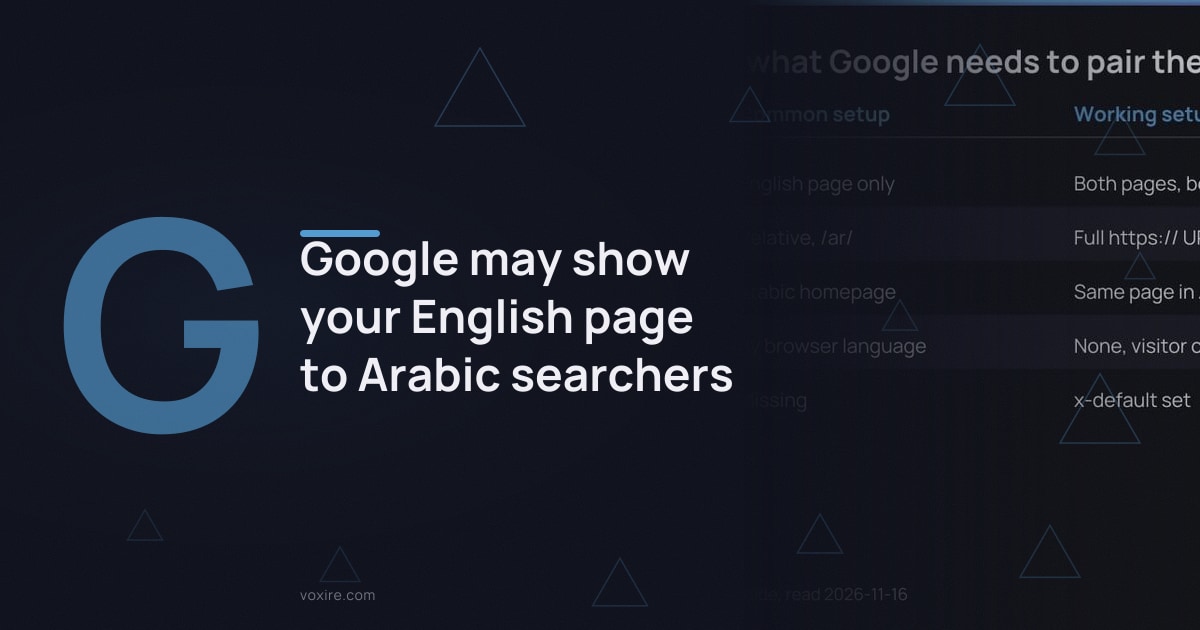
An Arabic version only reaches Arabic searchers when Google knows which English page it translates: how hreflang pairs them, where Lebanese sites break it, and how to check.
Most bilingual sites tell Google about their translations badly. An Ahrefs study of 374,756 domains found issues in 67% of hreflang setups, and a broken setup means an Arabic searcher can be shown your English page instead.
For a Lebanese firm that paid for a full Arabic version, that is money spent on pages nobody is sent to. The fix is small and technical, and it is part of the SEO work we do for Lebanese businesses. We run the same checks on our own Arabic and English site in every build.
Why do Arabic searchers land on your English page?
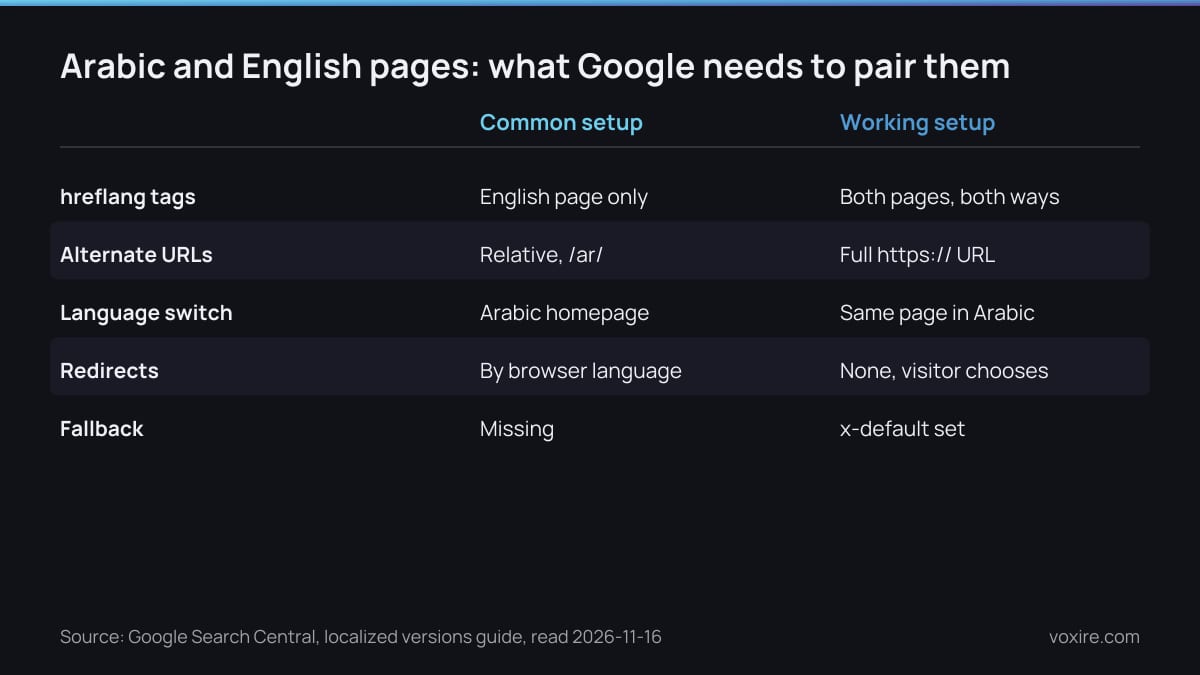
Because Google was never told the two pages are translations of each other. Google's guide to localized versions says each language version must list itself and every other version, and if two pages do not both point to each other, the tags are ignored. One-way tags count for nothing.
The common Lebanese setups that break it:
- A plugin adds the tags to the English pages but not the Arabic ones.
- The Arabic pages were added a year later by a different developer.
- The tags use short paths like /ar/ instead of full addresses.
- The language switch sends every reader to the Arabic homepage.
- English menus and footers sit on the Arabic pages, so the page reads as mixed.
The last one matters more than owners expect. Google's multi-regional guide says it detects language from visible content, not from code, and recommends one language for both content and navigation on each page.
That is also why the HTML lang attribute alone does not fix it. MDN describes lang as the page's declared language, which browsers and screen readers use. Set it correctly, ar on Arabic pages and en on English ones, but do not expect it to pair your pages in search.
The stakes are higher in Lebanon than in a one-language market. Lebanese people online, 91.8% of the population or about 5.38 million by DataReportal's 2026 count, search in Arabic, English and French. A clinic, law firm or contractor can lose the Arabic searcher without ever seeing it in the numbers, because that visit simply goes to a competitor whose Arabic page was paired.
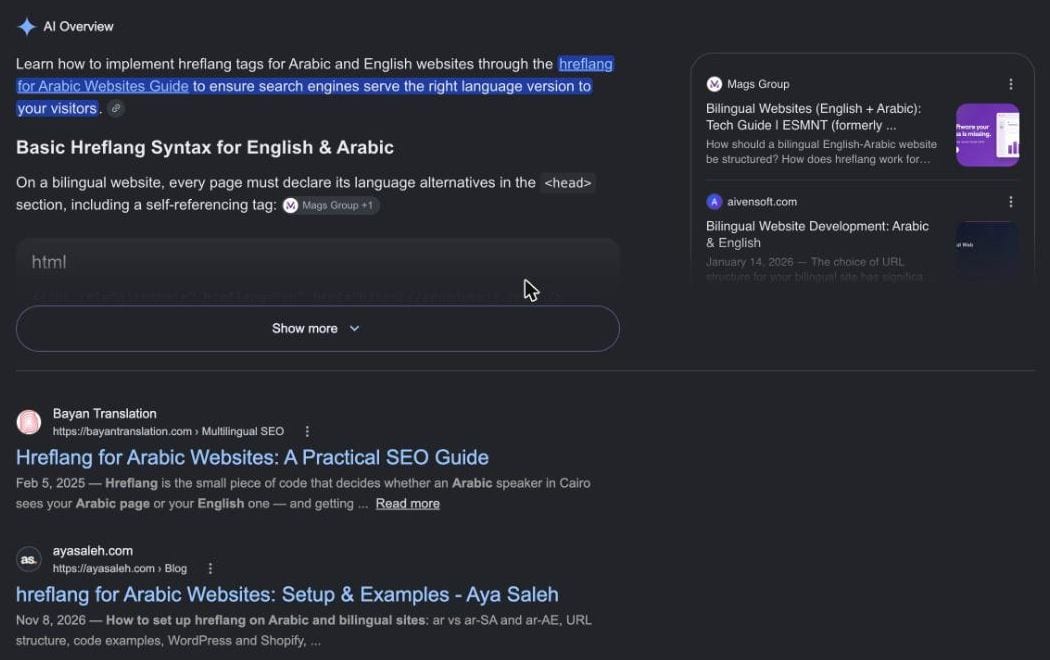
What are the best practices for implementing hreflang tags?
Pair every page with its translation in both directions, use full https addresses, and add an x-default fallback. Keep each page in one language, link the switch to the matching page, and never redirect visitors by guessing their language. Those rules come straight from Google's own documentation.
The language code matters less than people think. Plain ar for Arabic and en for English is correct for a Lebanese site with one version of each. Region codes such as ar-LB, built on the language tag standard, only help when you run separate pages for separate countries.
A French version follows the same rules. Every page then lists three alternates, all three must agree, and the cost of a mistake grows with each language. Our guide to English, Arabic and French sites covers when a third language is worth building at all.
How do I add hreflang?
Add a set of link tags to the head of every page, one per language version plus one for itself. WordPress plugins such as WPML or Polylang write them for you; a custom site needs its template to generate them. Google treats tags, HTTP headers and sitemap entries as equivalent, per its localized versions guide.
On the English services page of a Beirut firm, the head would carry three lines: one naming the English page, one naming the Arabic page, and one x-default pointing at whichever version should catch everyone else. The Arabic page carries the same three lines, unchanged.
Each line has two parts that owners often mix up. The href is the full address of a page. The hreflang is the language code of that same page, so the Arabic address always sits next to ar, never next to en. A swapped pair is one of the quietest errors we find, because nothing on the page looks broken.
Pick one method and keep it. Running tags and a sitemap together brings no benefit in Search, and it gives you two places to fall out of step. On our own site, a link check that reads every hreflang address once caught tags pointing at Arabic pages that did not exist yet. A crawler would have been sent to a dead page for each one.
The right-to-left design guide covers the Arabic pages themselves. Hreflang only gets searchers there.
Should your site redirect visitors by language?
No, let the visitor choose and remember the choice. Google warns that its crawler usually comes from the USA and sends no Accept-Language header, so a site that redirects by browser language or location may never show Google its Arabic pages.
The same redirect hurts people. A Lebanese reader on an English phone who searched in Arabic gets bounced to English. A diaspora visitor in Paris gets French they did not ask for.
The switch itself has to land on the matching page. A visitor reading your English pricing page who taps Arabic should see Arabic pricing, not the Arabic homepage. We fixed a language menu on a client platform last week that kept a stray page anchor in the address and dropped readers in the wrong place. The tags were fine; the switch was not.
What does fixing hreflang cost?
On most small Lebanese sites the fix takes hours, not weeks, and it costs far less than the Arabic copy it rescues. The tags, the switch and a monthly check are part of technical SEO, which starts at $600 a month in our published price list.
| Problem | Who usually fixes it | Effort |
|---|---|---|
| Tags on English pages only | Developer or plugin setting | Small |
| Relative addresses in the tags | Developer, in the template | Small |
| Language switch lands on the homepage | Developer, in the menu | Small to medium |
| Redirects by browser language | Developer and hosting | Medium |
| English menus on Arabic pages | Translator and developer | Medium |
| Arabic pages missing for key English pages | Writer, translator, developer | Largest |
Source: Google localized versions guide, read 2026-11-16
The last row is the expensive one, and it is a content decision rather than a code fix. If your Arabic version covers only the homepage and contact page, hreflang cannot send Arabic searchers to service pages that do not exist.
Our Beirut and Dubai price comparison shows what bilingual SEO costs when it is bought as a full service.
What should you actually do this week?
Open one English service page and its Arabic twin, view the source of each, and look for lines containing hreflang. If either page lacks them, or they point one way only, Google is guessing. That check takes ten minutes and needs no tools.
- View source on one English page and search for hreflang.
- Do the same on its Arabic twin and confirm each names the other.
- Tap the language switch on a deep page and see where it lands.
- Open the site in a private window and check nothing redirects you.
- List which English pages have no Arabic version at all.
Sources
- Google's hreflang documentation for translated pages, read 2026-11-16
- Google's advice for sites in several languages and regions, read 2026-11-16
- DataReportal: Digital 2026, Lebanon, read 2026-11-16
- Ahrefs: hreflang guide and study, read 2026-11-16
- RFC 5646: tags for identifying languages, read 2026-11-16
- MDN: the lang attribute, read 2026-11-16
Need your Arabic pages to reach Arabic searchers?
We check every pair of pages, fix the tags and the language switch, and crawl the site again to confirm every pair points both ways. Send us your site and we will tell you how many pages Google is guessing on today.
Enjoying this article?
Enter your email and get a clean, formatted PDF of this article: free, no spam.
Voxire
SEO in Lebanon
Technical SEO, local search, and bilingual Arabic-English content for Lebanese businesses. Audits, keyword research, on-page work, and the link building that actually moves rankings in a market where most competitors have never run one.
Learn more