Most businesses in Lebanon and MENA that ask this question have already outgrown spreadsheets and need a real system. The answer is almost never purely one or the other and almost always depends on how deeply your operations differ from standard workflows.
The question arrives in different forms. A restaurant chain owner in Beirut wants to know whether to buy a POS software subscription or build a custom system. A wholesale distributor in Tripoli wants to know whether Zoho or Odoo will work or whether they need something built to their specific processes. A logistics company serving the Gulf wants to know if an off-the-shelf TMS handles their requirements or whether they need custom development.
Under all of these questions is the same fundamental choice: do you adapt your operations to fit a standard software product, or do you build software that fits your specific operations? This is the SaaS versus custom development decision, and there is a structured way to make it.
What SaaS platforms actually give you
SaaS platforms like Zoho, Odoo, HubSpot, QuickBooks, and their vertical-specific equivalents deliver three things that are often underappreciated when comparing them to custom development.
First, they give you years of operational thinking baked into the product. The workflows, the edge cases, the reports that appear in a well-established SaaS product represent thousands of hours of problem discovery and product refinement across many businesses similar to yours. The purchase order workflow in Odoo exists because many distributors hit the same problem and the product evolved to handle it. You benefit from that accumulated thinking on day one.
Second, they give you ongoing development without ongoing investment. A SaaS product with 50 engineers updating it every quarter is adding features, fixing bugs, and improving security on a schedule that no single business could afford to fund independently. Your monthly subscription purchases access to that development velocity.
Third, they de-risk the operational continuity. If your custom-built ERP is maintained by an internal developer who leaves, or by an agency that deprioritizes your project, you have a serious operational risk. A SaaS platform with real institutional backing continues to exist regardless of any single relationship.
What SaaS platforms cannot give you
The limitations of SaaS platforms are equally real and are often what drives companies in Lebanon and MENA to consider custom development.
SaaS products are designed for global markets with standard operational patterns. Lebanese businesses frequently have workflows that diverge from these patterns because of regulatory requirements, because of the currency structure, because of specific market conventions in sectors like food distribution or retail, or because of integration requirements with systems that no Western SaaS vendor has invested in supporting.
A Lebanese restaurant chain that needs its POS to handle multiple currency pricing, offline operation during power outages, integration with a specific local accounting system, and daily cash reconciliation workflows that match local auditing practices will find that standard SaaS POS products require significant workarounds or manual steps that negate the efficiency benefit.
A pharmaceutical distributor in Lebanon with specific batch tracking requirements, temperature chain documentation, and regulatory reporting formats will find that the pharmaceutical modules in standard ERP platforms were designed for US or EU regulatory environments, not for the Lebanese Ministry of Public Health requirements.
The five-question framework for the decision
This decision framework is what we walk through with companies in Lebanon and MENA before recommending a direction.
Question 1: How different are your workflows from standard practice?
If you run a standard retail shop, a standard restaurant, or a standard professional services firm, your workflows are close enough to what SaaS products were designed for. Buy the SaaS product.
If your workflows involve specific regulatory compliance, multi-party coordination with other local businesses or government entities, currency handling specific to the Lebanese market, or deep integration with equipment or systems that SaaS vendors do not support, you are probably looking at customization needs that exceed what SaaS platforms handle well.
Question 2: What is your expected number of users and transaction volume in 3 years?
SaaS platforms typically price by user or by transaction volume. A business that expects 50 users in three years will pay $50 to $300 per user per month for an enterprise SaaS platform, which is $30,000 to $180,000 per year. At that price point, custom development that serves your specific needs begins to make economic sense, especially in the Lebanese and MENA context where dollar pricing is a significant cost. See also: Custom Software vs SaaS for the topic-specific playbook. See also: Why We Replaced Offset Pagination with Cursor Pagination in Our for the topic-specific playbook.
Question 3: What is your data sensitivity and compliance requirement?
For businesses handling sensitive client data in Lebanon, the question of where data is stored matters. Most SaaS platforms store data on US or EU servers. For some Lebanese businesses, this is unproblematic. For others, particularly in financial services or healthcare, there are concerns about data sovereignty that favor on-premise or custom solutions hosted within the region.
Question 4: What is the cost of your team adapting to the software versus the software adapting to your team?
This is the most underestimated cost in the analysis. Implementing an ERP across 20 employees in Lebanon typically requires 3 to 6 months of change management, training, and workflow redesign. If the software requires major process changes, the hidden cost of that adaptation is significant. If the software fits your processes closely, the adaptation cost is low.
Question 5: Do you have or can you afford the technical capacity to maintain custom software?
Custom software requires ongoing maintenance. Bugs get fixed, features get added, integrations break when third-party APIs change, and the software needs to be updated as your business grows. If you cannot commit to either an internal technical team or an ongoing relationship with a development agency, custom software carries a real risk of becoming unmaintained and eventually unusable.
The hybrid answer: when to use both
The best outcome for many Lebanese and MENA companies is neither pure SaaS nor pure custom development but a targeted hybrid.
Use a SaaS platform for the standard functions. Accounting, HR, basic CRM, email marketing. Standard platforms handle these well and the cost of building them from scratch is not justified.
Build custom for the differentiated operations. The specific workflow that your business does differently from everyone else. The integration between your warehouse system and your logistics partners. The reporting format your operations team actually uses. The POS interface that works for your specific product catalog and pricing structure.
For RTYLR, the commerce operating system Voxire built for restaurants and retail in Lebanon and the region, this is exactly the pattern. RTYLR handles the specific operational requirements of Lebanese restaurants that no global POS platform addresses correctly: the ordering flow, the menu structure, the printer routing, the reconciliation workflow. Standard SaaS handles the adjacent functions like email marketing and business analytics where the requirements are generic.
What the build actually costs in Lebanon
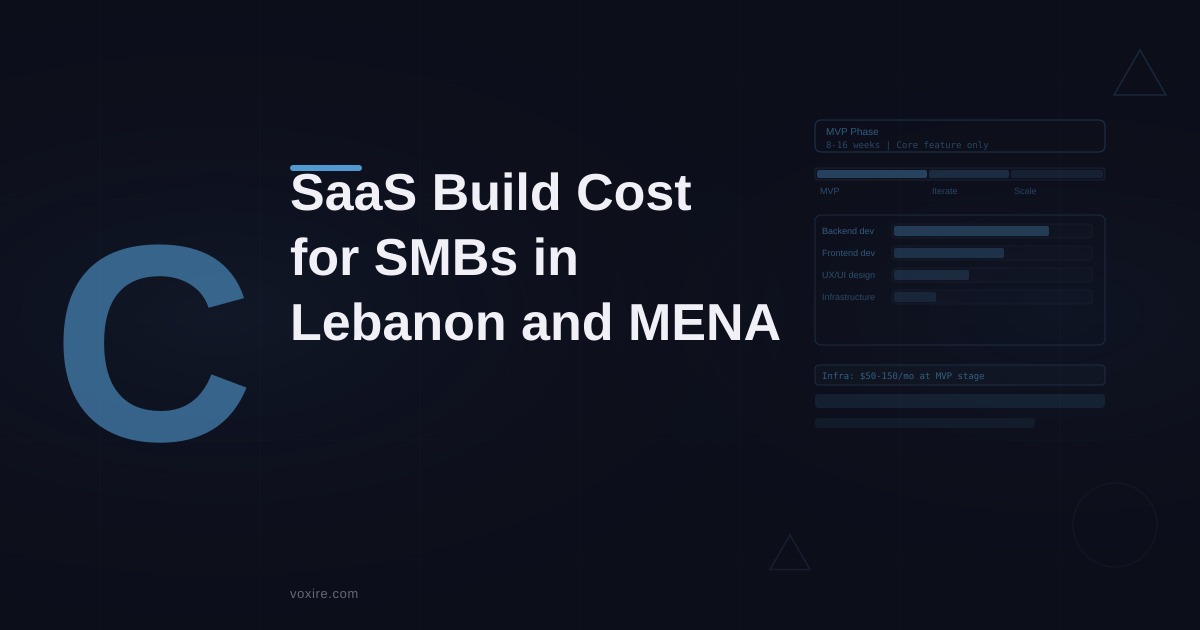
Custom software development in Lebanon and the MENA region has a different cost structure than in Western markets. A custom internal operations system built by a Lebanese development agency with real engineering capability typically costs USD 20,000 to 80,000 for the initial build, depending on scope and complexity, plus USD 1,000 to 5,000 per month for ongoing maintenance and feature development.
A comparable SaaS platform with equivalent functionality at scale typically costs USD 500 to 3,000 per month for a mid-sized Lebanese business. At 24 months, the SaaS cost equals USD 12,000 to 72,000. At 36 months, USD 18,000 to 108,000.
The crossover point where custom development becomes more cost-effective than SaaS is typically between 18 and 36 months, assuming the custom software meets your needs correctly. If the custom software has ongoing technical debt, poor documentation, and requires frequent emergency fixes, the economics reverse.
Key considerations for the MENA context
A few factors that specifically affect this decision for businesses operating in Lebanon and the broader MENA region.
Currency and payment infrastructure. Lebanese businesses operating in both LBP and USD need software that handles multi-currency correctly. Very few SaaS platforms handle the specific Lebanese banking and payment context. This is frequently a driver toward custom development.
Local regulatory requirements. VAT reporting, trade license documentation, and industry-specific regulatory filings in Lebanon and Gulf states have specific formats that standard SaaS accounting tools may not support without manual exports and reformatting.
Connectivity and offline requirements. Power and internet reliability in Lebanon makes offline capability a real operational requirement, not just a nice-to-have. Most cloud SaaS products do not work well in offline conditions. Custom systems can be architected for offline-first operation.
Enjoying this article?
Enter your email and get a clean, formatted PDF of this article: free, no spam.
Not sure where to start?
Voxire helps companies in Lebanon and MENA evaluate whether to buy, build, or combine platforms and then executes the right technical path. If your team is facing this decision, we can help you structure the analysis.
Voxire
SaaS for MENA
SaaS built for the MENA market. Arabic-first product design, regional payment infrastructure, data residency for Saudi Arabia and the UAE, and the B2B sales motion that works in a region where the playbook from San Francisco does not.
Learn more